



Your eyes are muscles. Like any muscle, they respond to training, and they break down when overworked without recovery.
So if you spend hours in front of screens, you already know what that breakdown feels like: the headaches, the blur, the focus that goes soft by mid-afternoon.
Now, eye exercises won't rewrite your prescription, but they can meaningfully reduce that daily toll.
This guide covers the science behind vision training, six exercises you can do at home, and what else you need to protect your eyes in a world built around screens.

In this article:
The Science of Vision Training and Eye Exercises
Eye exercises work on the muscular and coordination side of your visual system, not the structural side. Refractive errors (myopia, astigmatism, or genetic farsightedness) are caused by the physical shape of the eye or cornea. No exercise can change that.
What exercises can address is how well your eyes work together, how efficiently they shift focus, and how much stamina they have under prolonged demand, particularly from screens.
The American Academy of Ophthalmology (AAO) is clear that exercises won't sharpen vision affected by refractive errors. Where they do have strong clinical support is convergence insufficiency, a common condition where the eyes struggle to work together during near focus tasks like reading or screen work.
And NIH clinical research shows that structured convergence exercises produce significant, lasting improvement in symptoms for the majority of people who do them consistently.
As for the "improve your vision in 7 days" trend circulating online: treat it as the myth it is. Eye muscle stamina and tracking accuracy improve gradually, the same way any physical conditioning does.
Realistic timelines involve weeks of consistent practice, not a weekend routine. That said, many people notice reduced eye fatigue and faster refocusing within a couple of weeks of regular exercise.
The exercises below target the strain patterns most common in screen-heavy work: overworked convergence, sluggish focus shifting, reduced blinking, and the general fatigue that builds from hours of close digital work.
6 Vision Therapy At-Home Exercises for Daily Relief
None of these require equipment. A few minutes a day, done consistently, beats longer sessions you'll skip.
1. The 20-20-20 Rule
Best for: digital eye strain, general fatigue
This is the most evidence-backed habit for anyone who works at a screen, and it costs you nothing but 20 seconds. Every 20 minutes, look at something at least 20 feet away for 20 seconds. It forces your ciliary muscles to release the contracted state they've been holding all day.
How to do it:
-
Set a timer for every 20 minutes while working.
-
Look at a fixed object at least 20 feet away.
-
Hold your gaze softly for a full 20 seconds before returning to your screen.
2. Focus Shifting (Near-Far Switching)
Best for: blurry vision, accommodation weakness, farsightedness
If your vision takes a beat too long to sharpen when you look up from your phone, your accommodation reflex is sluggish. This is one of the most practical vision strengthening exercises you can do: it trains the eye to switch focus quickly between near and far distances.
How to do it:
-
Hold a finger or pen about 6 inches from your nose.
-
Focus on it clearly for 2–3 seconds.
-
Shift focus to an object 10–15 feet away. Hold for 2–3 seconds.
-
Repeat 10 times. Do this 2–3 times daily.
3. Figure-Eight Eye Tracking
Best for: eye tracking, coordination, eyeball muscle control
Smooth pursuit tracking (the ability to follow a moving object cleanly) is one of the first things to degrade with digital overuse. Most screen work trains your eyes to stay fixed, not to move. This eyeball exercise rebuilds that controlled, fluid movement.
How to do it:
-
Imagine a large figure eight (or infinity symbol ∞) about 10 feet in front of you.
-
Trace the shape slowly with your eyes, without moving your head.
-
Continue for 30 seconds in one direction, then reverse.
-
Repeat 2–3 sets.

4. Pencil Push-Ups (Convergence Training)
Best for: convergence insufficiency, double vision, eye fatigue during reading
When convergence is weak, reading and close work become exhausting fast. Pencil push-ups are the most clinically studied at-home exercise for convergence insufficiency. They're simple, they take two minutes, and they work.
How to do it:
-
Hold a pencil at arm's length, tip pointing up.
-
Slowly bring it toward your nose, keeping both eyes focused on the tip.
-
Stop when you see it double, or when you can no longer keep both eyes on it.
-
Slowly move it back out. Repeat 10–15 times per session.
-
Do this once or twice daily for best results.
5. Palming
Best for: eye fatigue, light sensitivity, overstimulation
Recovery is part of training. Palming gives the optic nerve and surrounding muscles a full break from light input. It's one of the best things you can do at the end of a long screen day, and most people feel the difference within the first minute.
How to do it:
-
Rub your palms together until they're warm.
-
Cup them gently over your closed eyes without applying pressure to the eyeballs.
-
Breathe slowly and hold for 1–2 minutes.
-
The goal is complete darkness and stillness. Many people notice immediate tension relief.
6. Blinking Reset
Best for: dry eyes, blurry vision from screen use, surface irritation
Screen users blink roughly 50% less than normal. That alone explains a lot: the dryness, the grittiness, the hazy blur that builds through a workday. A deliberate blinking reset refreshes the tear film and clears vision that's gone soft from dryness rather than any structural problem.
How to do it:
-
Close your eyes fully and hold for 2 seconds.
-
Open wide. Blink rapidly 5 times.
-
Repeat the close-hold-open-rapid sequence 4–5 times.
-
Do this every hour, or any time your vision feels hazy or dry.
Beyond Exercises: Protecting Your Sight from Digital Strain
Eye exercises address the muscular side of visual health. But if your eyes are constantly hit with harsh light between sessions, the gains are harder to hold. Think of it like training hard in the gym while sleeping badly; the work is real, but the recovery isn't there to back it up.
One of the biggest stressors most people aren't managing is blue light: the high-energy wavelengths emitted by screens and LED lighting that suppress melatonin, keep the nervous system stimulated, and contribute to the visual fatigue that compounds across a full day of screen use.
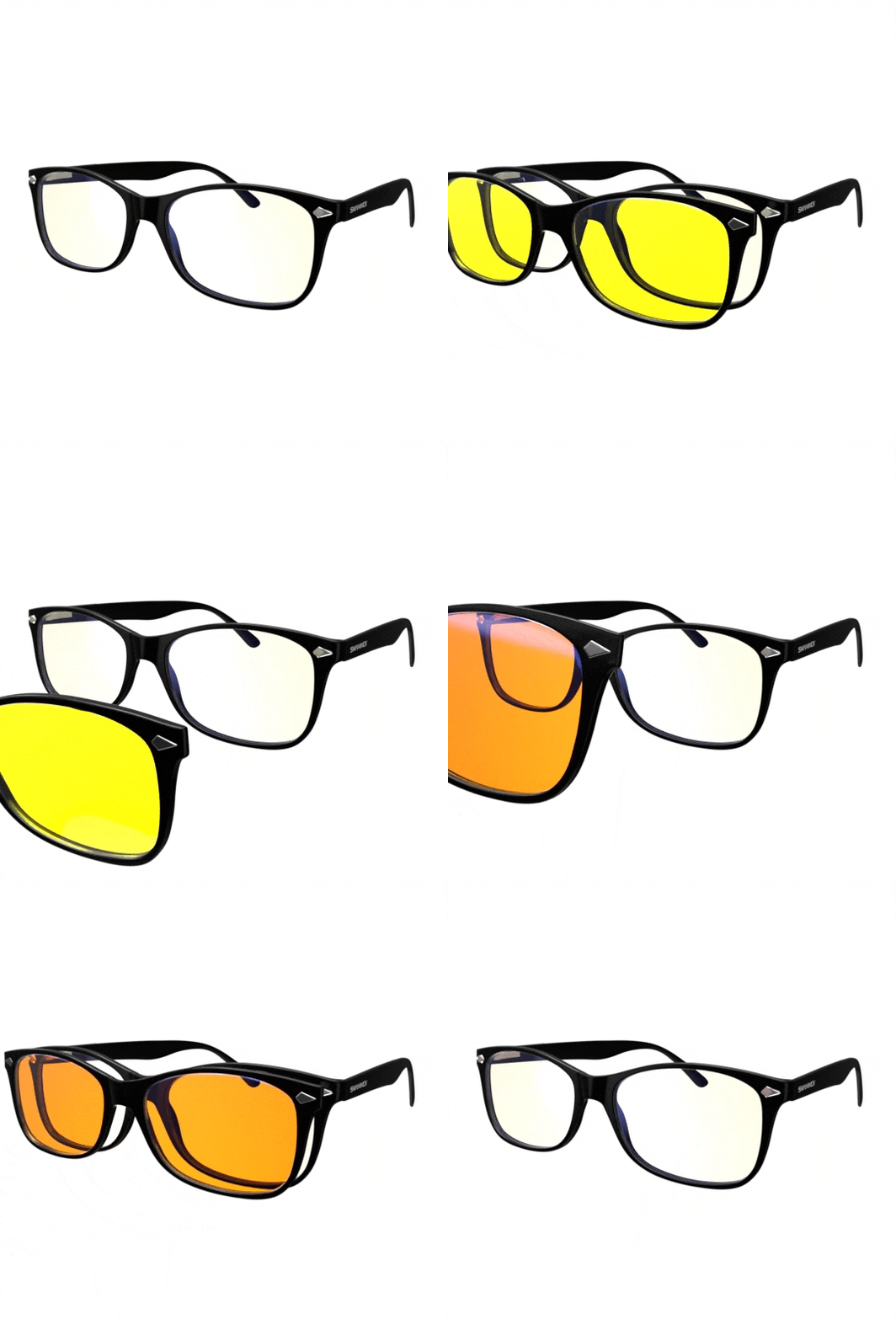
The fix is light management throughout the day, not just at bedtime. During work hours, Focus Swannies filter the high-energy wavelengths (400-450nm) linked to eye strain and fatigue, without touching color perception or alertness.
And in the evening, Sleep Swannies block the blue and green spectrum that suppresses melatonin, signaling to your brain that the day is done. Well-rested eyes recover faster, adapt better, and respond more effectively to the training you're putting in.
Exercises and light management aren't competing approaches. They're the active and passive sides of the same goal: a visual system that performs all day and recovers all night.
Start with two or three exercises from the list above. Build a short daily routine. Manage your light exposure in the hours you're not actively training. That combination, done consistently, is what actually moves the needle.
Your eyes work hard. Start giving them the same attention you give everything else.


