


What actually changes when you wear them?
In an independent four-week study, SleepScore Labs tracked people wearing Sleep Swannies before bed.
Their sleep improved by almost every measure.
Here's the SleepScore Labs validated findings:
11 Mins
faster to fall asleep
24 Min
less time awake at night
37%
more likely to wake rested
73%
said their sleep improved
14%
more time in deep sleep
14%
better quality sleep

Your body clock runs on light
For most of human history, sunset meant darkness, and darkness told your body to wind down. Screens and LED lighting changed that. The blue wavelengths they give off reach your eyes late into the evening and tell your brain it is still daytime.

We measure it, so you can read the proof
We have our lenses independently lab tested by Colts Laboratories, and we publish the full transmission reports.

37%
Focus Swannies proven to block 37% of blue light, 400–450nm.

90%
Relax Swannies proven to block 90% of blue light, 400–500nm.

99%+
Sleep Swannies proven to block over 99% of blue light, 400 to 550nm.


Better sleep = sharper the next day
A 2020 study by the University of Washington and Indiana University, published in the Journal of Applied Psychology and featured in Harvard Business Review, ran twice.
Both times, evening Swannies wearers slept better and worked better the next day.
Trial 1 Results
- Slept 6% longer
- Sleep quality up 11%
- Task performance up 9%
- Work engagement up 8.25%
- Helping behavior up 18%
- Negative work behavior down 12%
Trial 2 Results
- Slept 5% longer
- Sleep quality up 14%
- Task performance up 7%
- Work engagement up 8.5%
- Helping behavior up 17%
- Negative work behavior down 12%
We're rated among the top of the pack
At the University of Arizona, Dr. Michael Grandner tested 50 lenses from a range of brands.
Sleep Swannies came out among the top performers for blocking sleep-disrupting light.
"They combine effectiveness at filtering sleep-disrupting light while also allowing in non-sleep disrupting light, striking the right balance between sleep benefits and wearability and thus allowing for comfortable reading, screen viewing and night time activities without appearing too dark."

Wider Research
The science goes deeper. Read more studies on the benefits of blue light blocking glasses

Columbia University,
USA
Randomized controlled trial: amber lenses are a safe, low-cost, easy option for improving insomnia symptoms.

University of Basel,
Switzerland
Blue-blocker glasses reduced melatonin suppression and evening alertness from LED screens in teens.

Keio University,
Japan
Better sleep quality reported in adults after using blue-light-shield eyewear with devices at night.

Laval University,
Canada
Orange lenses blocked bright light's ability to suppress melatonin production, regardless of gender.
Still need more proof?
Medical Studies Proving The Benefits Of Blue-Light Blocking Glasses
- Rodriguez. Advanced Sleep Medicine Services. "Why You Should Wear Blue Light Blocking Glasses Tonight." 2014.
- Journal of Adolescent Health. "Blue Blocker Glasses As A Countermeasure For Alerting Effects of Evening Light-Emitting Diode Screen Exposure In Male Teenagers." 2014.
- Galbraith. New York Times. "Can Orange Glasses Help You Sleep Better?" 2015.
- Chronobiology International. “Amber lenses to block blue light and improve sleep: a randomized trial.” 2009
- Chronobiology International. “Wearing blue-blockers in the morning could improve sleep of workers on a permanent night schedule: a pilot study.” 2009
- Journal of Pineal Research. “Blue blocker glasses impede the capacity of bright light to suppress melatonin production.” 2006
- Bennett. “Use of modified spectacles and light bulbs to block blue light at night may prevent postpartum depression” 2009
- Dove Medical Press. “Treatment of attention deficit hyperactivity disorder insomnia with blue wavelength light-blocking glasses” 2013
- Bipolar Disorders. “Blue-blocking glasses as additive treatment for mania: a randomized placebo-controlled trial” 2016
- International Business TImes. “Sleep Faster With A Pair Of Orange-Tinted Eyeglasses” 2015
- The Conversation. “Can wearing orange-tinted glasses before bed help you sleep? Only one way to find out…https://theconversation.com/can-wearing-orange-tinted-glasses-before-bed-help-you-sleep-only-one-way-to-find-out-40684” 2015
Medical Studies Proving The Danger of Blue-Light Exposure
- Harvard Medical School. “Blue light has a dark side” 2015
- Environmental Health Perspectives. “What’s in a Color? The Unique Human Health Effects of Blue Light” 2010
- Scientific Reports. “Damage of photoreceptor-derived cells in culture induced by light emitting diode-derived blue light” 2014
- Sleep Medicine Clinic. “Effect of Light on Human Circadian Physiology” 2009
- Fox News. "How blue light affects children’s eye health” 2014
- Catching Health. "Using Technology Before Bed." 2015
- VSP Vision Care. "Blue Light And The Effects On Our Eyes." 2015
- Fox News. "Blue Light Exposure And Our Eyes." 2016
- Frontiers in Public Health. “Bigger, Brighter, Bluer-Better? Current light-emitting devices – adverse sleep properties and preventative strategies” 2015
- Lux Magazine. "Apple Move Acknowledges Blue Light Danger." 2016
- KTVK3TV. "Blue light from tech devices could be harming your eyes." 2014
- Chang. “Evening Use Of Light-Emitting eReaders Negatively Affects Sleep”. 2014
- Patel. U.S. National Library Of Medicine. "Short Sleep Duration And Weight Gain." 2008
- National Sleep Foundation. "Obesity And Sleep."
- Aguillon. University of Toledo. "Dangers of Blue Light Exposure." 2015
- Phelps. Corvallis Psychiatric Unit. "Dark Therapy For Bipolar Disorder Using Amber Lenses For Blue Light Blockade." 2008
- Current Biology. “Entrainment of the Human Circadian Clock to the Natural Light-Dark Cycle” 2013
- Journal of Biological Rhythms. "Entrainment of the human circadian system by light" 2005
- The Journal of Clinical Endocrinology & Metabolism. “Exposure to Room Light before Bedtime Suppresses Melatonin Onset and Shortens Melatonin Duration in Humans” 2010
- Journal of Biological Rhythms. “Access to Electric Light Is Associated with Shorter Sleep Duration in a Traditionally Hunter-Gatherer Community” 2015
- ESPN. “Hurt locker rooms: The four injury risks today's young players face” 2015
- Scientific American. “Q&A: Why Is Blue Light before Bedtime Bad for Sleep?” 2015
- Psychology Today. “Blocking Blue Light Helps Sleep?” 2013
- Los Angeles Times. “Reading on iPad before bed can affect sleep habits” 2010


Looking for the simplest way to take control of your sleep, energy, and focus?
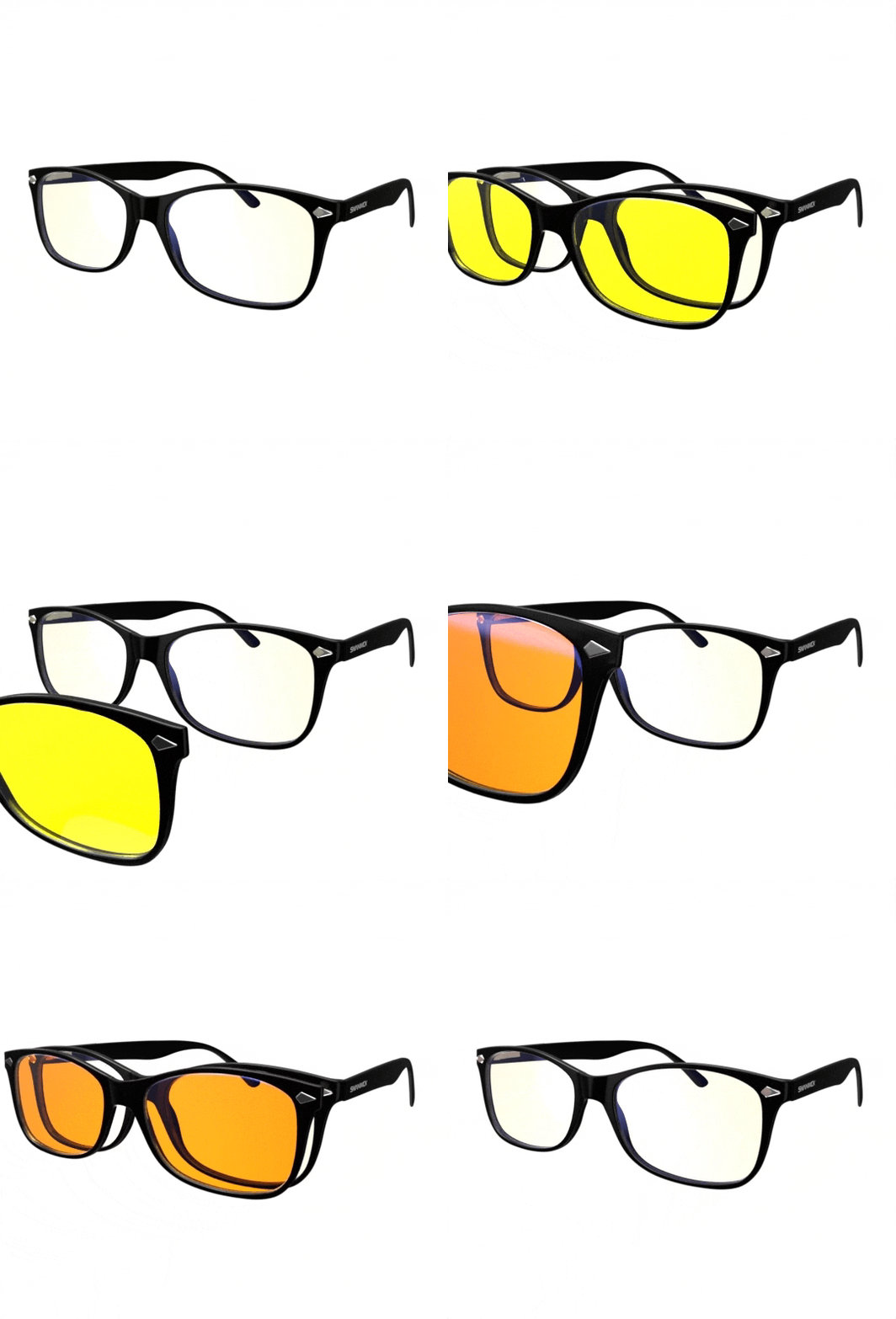
The Circadian Snap-On Set is a complete light management system designed to support your body’s natural rhythm in a world of screens and artificial lighting, without adding more tech to your performance stack.
Built around an almost-clear Focus base pair, the system includes two precision magnetic snap-on lenses: Relax to help you unwind in the evening, and Sleep for powerful nighttime melatonin protection. Instantly adapt to your environment by switching lenses throughout the day, supporting sharper focus, calmer evenings, and deeper, more restorative sleep.
No apps. No supplements. No changing your routine. Just one pair, three lenses, and full control over your light exposure from morning to night.
Blue-banned Swannies feature a bold rectangular silhouette crafted from premium acetate, inspired by the iconic Wayfarer style. Lightweight and comfortable for all-day wear, this flexible, durable unisex frame offers a modern oversized fit that remains timeless. Includes our innovative magnetic Circadian Snap-On lens system.
Premium foldable case is included.


